
Juhudi Kilimo is changing the way farmers do business. We finance targeted agricultural assets for smallholder farmers and rural enterprises across Kenya. Operating exclusively in very rural areas, we give smallholder farmers access to the tools they need to scale up and succeed.
Our Mission
To provide market driven, wealth-creating financial services that empower smallholder farmers and rural enterprises to create sustainable agri-businesses and improve their livelihoods.
Our Vision
To reach 100,000 farmers by 2015 with superior financial services for agri-business.
Asset Financing and Insurance
Unlike traditional microfinance, which primarily provides loans for working capital to informal businesses, Juhudi finances specific agricultural assets that offer immediate and sustainable income for farmers. The assets act as an alternative form of collateral in case of default, reducing the farmers’ risk of greater poverty through indebtedness, and assets are insured to protect clients from harsh business losses. This comprehensive approach creates long-term gains in productivity and local engines of economic growth.
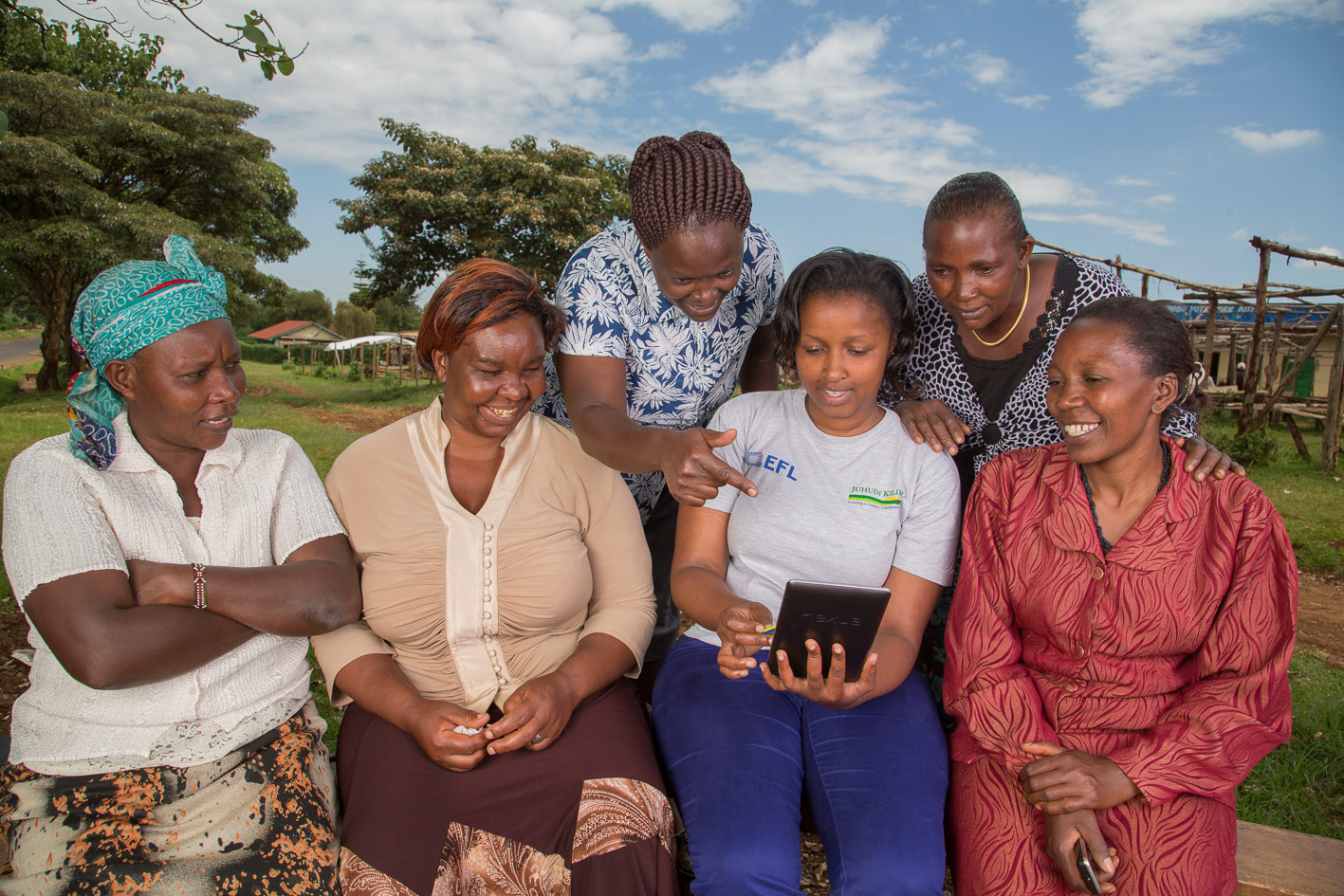
Training and Technology
Juhudi maximizes the benefit of asset financing by providing both technical assistance and business training. Prior to each loan, officers visit the client’s farm to perform a business assessment and advise on improvements. The first four meetings of a new group are then devoted to training clients on basic finance and business. After a loan is approved officers give continued support, working with partners and local government ministries to offer targeted technical assistance on assets. To best serve rural clients, Juhudi also uses mobile technology to collect payments and feedback and reduce the burden on clients and loan officers in these remote areas.
Solidarity Loan Groups
Juhudi’s clients support each other through solidarity loan groups, and co-guarantee their loans. Led by client representatives, groups function independently but with strong support and oversight from loan officers. Loan groups serve as a central meeting place for farmers to share ideas and encouragement, learn about new products and services, and organize for access to better pricing and markets.
Our History
Juhudi Kilimo began in 2004 as an initiative within K-Rep Development Agency, an NGO that performs research and product development for the microfinance sector. In 2009, Juhudi became an independent for-profit company and is projected to grow to reach 100,000 clients by 2015.
Juhudi Kilimo has over forty employees in the Nairobi head office and in its seven field offices in rural communities across Kenya.
Juhudi Kilimo Management
Nat Robinson, CEO
Nat joined Juhudi in 2008 through the MBA Enterprise Corps and served as the interim CFO and General Manager. In July of 2009, he was awarded sponsorship by the UNDP and IFC African Management Services Company (AMSCO) to continue working with Juhudi as the full time General Manager and CFO. He became CEO in October of 2010. Nat has a background in international financial consulting, working as a consultant with Accenture in Washington D.C. and with Expat-CFO in Shanghai. He has an MBA from Vanderbilt University in Tennessee.
Benjamin Kimosop, COO
Benjamin was recently promoted to oversee the field operations at Juhudi and previously managed the Rift Valley region as the Regional Manager. He helped build the Kitale field office into one of the best performing regions and recently opened a field office in Eldoret. He also brings experience in operations and management from SISDO, a larger Kenyan microfinance institution.
Steve Mutai, Chief Accountant
Steve began with Juhudi Kilimo after holding several positions with K-REP bank, including Management Information Officer, Finance Officer, and Project Accountant. Steve has a Bachelor degree in Accounting, a Kenyan CPA, and an IT Diploma, and an MBA. He has also been a university lecturer on finance and accounting. In June 2011, Steve joined the Acumen Fund's inaugural class of East African Fellows.
Juhudi Kilimo Board
Bethuel Kiplagat, Chairman
Mr. Kiplagat is a Career Diplomat, and has held various positions in both private and public sectors. He is a former Permanent Secretary in the Ministry of Foreign Affairs, Kenya’s Special Envoy to the Somalia Peace Talks, and the Chancellor of Egerton University. Mr. Kiplagat holds a Bachelor of Science degree in Physics and Chemistry from The Sorborne University in Paris.
Dr. Kabiru Kinyanju, Board Member
Dr. Kinyanjui is the vice chairman of the K-Rep Group and Chairman of the boards of K-Rep Advisory Services and the K-Rep Group Provident Fund. He is widely published, best known in the microfinance sector for co-authoring the book “Indigenizing foreign seed on African soil: The Story of K-Rep”. He helped establish and continues to serve on the board of the Nairobi Peace Initiative- Africa (NPI-A). Dr. Kinyanjui has been the Chairman of the Public Universities Inspection Board, which recently published a report entitled, “Transformation of Higher Education and Training in Kenya to Secure Kenya’s Development in the Knowledge Economy”. He obtained a degree in Law, History, and Sociology from the University of East Africa in Dar es Salaam before proceeding to Harvard University for graduate studies.
Kimanthi Mutua, Board Member
Mr. Mutua is the founder of K-Rep Bank and a co-founder member of the K-Rep Group. He has devoted close to two decades to designing, developing, and running viable microfinance institutions. Mr. Mutua also serves as a member of various boards and advisor to several national and international institutions. He holds a Bachelors degree in commerce.
Aleke Dondo, Board Member and Former Managing Director
Mr. Dondo brings 21 years of experience in microfinance with the K-Rep Development Agency, a non-profit microfinance institution that services the needs of rural small-scale farmers and micro-entrepreneurs through innovative microfinance projects. Mr. Dondo has in-depth experience with the start-up and management of rural microfinance organizations and a background in small (informal) enterprise development. He holds a Master’s degree in economics from York University in Toronto and has carried out more than 30 major studies in the fields of small enterprise and microfinance development. Mr Dondo has published ten research papers on these subjects. He serves on the boards of other organizations involved in development work, including Kenya Gatsby Trust (Chairman), Kenya Community Development Foundation (Vice-Chairman), K-Rep Advisory Services, and Saga Thrift and Enterprise Promotion. Through October, 2010, he also acted as Managing Director of Juhudi Kilimo.
Juhudi Kilimo offers financing to smallholder farmers and enterprises for a variety of income-producing assets. Through these targeted loans, Juhudi helps build businesses that increase income, jobs, market access, and services for rural communities in Kenya.
Dairy
Financing for dairy cows and goats.

Livestock and Fish
Financing for poultry, pigs, rabbits, and other livestock, as well as fish farming.

Agricultural Equipment
Financing for a variety of farm equipment that add value and improve efficiency, including irrigation, agro-processing, and energy-related equipment.

Farm Transport
Financing for motorcycles, bicycles, and other vehicles specifically intended to transport farm goods.

Juhudi Kilimo is growing with the support of these partners.
Lend to a Juhudi Kilimo Entrepreneur:

Join the Lending Team:


While Juhudi Kilimo’s primary focus is the financial needs of smallholder farmers in Kenya, we also work to support and protect clients and strengthen the communities in which we work.
Social Performance Measurement
To measure its impact, Juhudi has employed the GIIRS rating system, the CERISE Social Performance Indicators evaluation, and the Grameen Foundation’s Progress Out of Poverty tool.
Outreach
As Juhudi operates exclusively in very rural areas, its products and services are shaped solely to the needs of smallholder farmers and agro-businesses. Juhudi also focuses on reaching out to female clients and employing female staff, both of which represent approximately half of the organization. To aid its poorest clients, Juhudi facilities small loan amounts, payment installments, and savings deposits.
Community
Juhudi’s field offices and solidarity groups are formed with the collaboration of local leaders, who often attend loan meetings. Loan groups are also enhanced by relationships with local businesses, government ministries, and development organizations. As a result, they are a conduit for continued education and a network for local services. The assets that Juhudi finances further enable clients to provide employment to members of the community.
Client Protection
Juhudi is committed to transparency in pricing and practices. Loan officers are trained to ensure that loan terms are clear to clients and to be responsive to clients' needs. To prevent over-indebtedness, officers and group peers assess the client’s business and assets at their farm during the application process, and the group members co-guarantee each other’s loans. The assets that Juhudi finances also act as an alternative form of collateral in case of default, and both clients and their assets are insured over the course the loan.
Client Benefits
Juhudi’s clients are provided with targeted training on new assets, as well as group management and leadership and finance principles. For example, clients with high-yield dairy cows often receive training on building an adequate zero-grazing unit, preventing common livestock diseases, and growing and storing napier grass.
While Juhudi is not a deposit-taking institution, clients are encouraged to save in excess of the 15% required savings in order to expand their capital base. Juhudi also requires credit life insurance (which also covers funeral costs) for the duration of every loan, and offers a medical aid plan as an optional benefit.
Food Security
Most of the assets that Juhudi finances produce not only an income for its clients but supplemental food for their families and communities. A farmer with a high-yield dairy cow producing over 20 liters a day can use several liters a day for family consumption and sell the reserve locally to generate enough income for loan repayments and other costs.